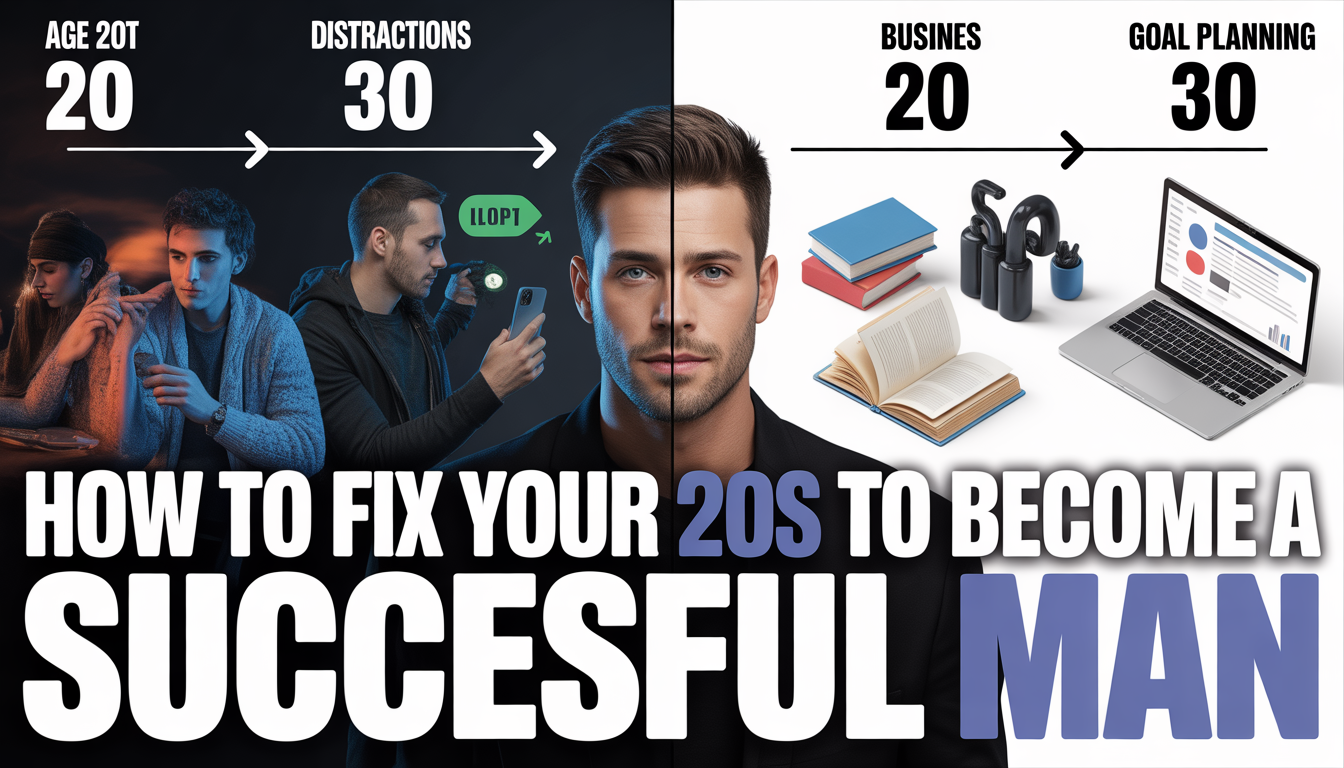
Listen carefully. You did not land here by accident. Somewhere deep inside, you already feel it. Something in your life is stuck. You are not lazy. You are not stupid. You have ambition. You have dreams. But somehow, your 20s are slipping through your fingers, one comfortable day at a time.
You tell yourself it is harmless. One more episode before bed. One more late-night gaming session. One more “talking stage” with someone who may or may not take you seriously. One more weekend wasted because “you deserve a break.” But deep down, you know overindulgence is quietly killing your potential. Comfort feels safe in the moment, yet it slowly robs you of the man you could become.
If you want to fix your 20s, you must first understand the traps keeping you average. And then you must have the courage to escape them.
The Entertainment Overload Trap:
Your biggest enemy right now is not failure. It is distraction. You average hours of screen time daily. Short-form videos, endless scrolling, binge-watching seasons, consuming “motivational” reels that make you feel productive without doing anything productive. You talk about business ideas with friends over tea, but there is no real execution behind those conversations.
This is mental masturbation. You confuse consuming content with creating results. You mistake discussing goals for pursuing them. The reason you avoid action is simple: action is uncomfortable. It demands risk, rejection, and the possibility of failure. Your comfortable digital bubble protects you from that discomfort.
Open your screen time statistics. Look at the truth. You do have time. You just choose to spend it escaping instead of building. It is easier to blame society, the government, your circumstances, or your background than to take brutal responsibility for your own habits.
Does this mean you must eliminate entertainment forever? Not necessarily. But understand this clearly: entertainment is earned, not entitled. If you are still in the trenches trying to build yourself, you cannot afford balance yet. There may be a season in your life where you need six to eight months of extreme focus. A period where you deactivate distractions, limit socializing, and disappear to rebuild yourself.
Transformation is rarely balanced. It is intense. It requires what feels like “dire measures.” There is a quote from Game of Thrones where Aemon Targaryen tells Jon Snow, “Kill the boy and let the man be born.” That is exactly what this phase demands. You must kill the comfortable, distracted version of yourself so the disciplined man can emerge.
Later, when you have built momentum, you can reintroduce controlled entertainment. But right now, you need focus more than comfort.
The Validation and Talking Stage Loop:
Your life feels chaotic because it is cluttered. You start three shows at once. You follow multiple influencers giving conflicting advice. You juggle conversations with multiple girls. You change your gym split every week. You switch diets after seven days because you do not see results.
This scattered approach spreads your energy thin. Your brainpower is limited. When you divide it across too many areas, you dilute your progress everywhere.
Imagine a different scenario. One business model. One workout plan. One mentor. One focused goal for six months. What would your life look like half a year from now if you simply committed to depth over variety?
Real progress comes from sustained focus. A month of intense, distraction-free work can produce more results than six months of half-hearted effort. If you constantly hop from opportunity to opportunity because a new trend appears online, you will remain a beginner forever.
Successful men understand one principle: do more with fewer things. Mastery requires patience. Choose a path and stay with it long enough to see results. Your 20s are not for sampling every option; they are for building competence in one.
The Social Life Illusion:
You believe having an active social life makes you valuable. You fear missing out. You hesitate to say no because you do not want to disappoint people. But ask yourself honestly: are the people you spend most of your time with pushing you forward or pulling you backward?
You become the average of those around you. If your circle normalizes mediocrity, comfort, and excuses, you will slowly adopt those standards. Even if you are ambitious, the collective influence of four complacent friends can overpower your drive.
Here is a hard truth: most of the friends you have today will not be in your life five years from now. If they are growth-oriented, supportive, and disciplined, they will evolve with you. If not, they will remain where they are while you try to climb.
Sometimes you must be selfish with your time to eventually become selfless with your impact. Protect your energy. Protect your focus. When you level up, your family benefits. Your future partner benefits. Your future children benefit. But that begins with temporarily choosing yourself over constant social validation.
Abnormal results require abnormal decisions. If you continue making comfortable, socially accepted choices, expect average outcomes. A mediocre job. Financial stress. Regret. The path is clear; the courage is your responsibility.
The Comfort Food and Comfort Body Cycle:
When you avoid uncomfortable actions, you still crave dopamine. So you seek it in food, junk habits, and instant gratification. Building a strong body takes time. Following a disciplined diet requires effort. It is easier to order fast food and promise yourself you will start “next week.”
But poor physical habits create a dangerous chain reaction. Bad diet leads to low energy. Low energy leads to skipping workouts. Skipping workouts leads to a weaker physique. A weak physique often leads to lower self-confidence. Lower confidence affects your business decisions, your risk tolerance, and your willingness to lead.
Your body and your mind are deeply connected. Conquering your body builds discipline. Discipline builds self-respect. Self-respect builds action.
Make it a rule to take one uncomfortable action daily. It could be waking up earlier. Finishing a hard task before noon. Completing a workout when you feel lazy. Small acts of discipline compound into identity change.
Adopt the habit of nightly self-audits. Spend ten minutes in silence and ask yourself: Did I improve today? Did I learn something new? Did I move closer to my goals? If a business never tracked its revenue or expenses, it would fail. Likewise, if you never track your growth, you will drift through life on autopilot.
Many self-improvement journeys begin in the gym because it is the most visible arena of discipline. A strong body signals commitment. It shows you can endure discomfort. And that trait transfers into business and leadership.
The Myth of Balance in Your 20s:
Social media often promotes “work-life balance” as the ultimate goal. But balance in your 20s can be a dangerous illusion. These years are your building phase. Someone your age is working while you rest. Someone is learning while you scroll. Someone is compounding effort while you are consuming comfort.
In previous generations, success often came later in life. Today, competition is global and hyper-competitive. Young men are building businesses, mastering digital skills, and earning more than older generations ever imagined at that age. They are not necessarily smarter. They are simply more decisive and more disciplined.
If you demand balance before you build leverage, you slow your own progress. There will be time for comfort later. But during your foundational years, intensity is often required.
The world will not stop you from wasting your prime. Your friends may encourage it. Society may normalize it. No one will intervene while you scroll your potential away. The responsibility to wake up is entirely yours.
You have two choices. Return to your comfortable habits and let another year disappear. Or take radical ownership of your time, cut one destructive habit for thirty days, and commit to uncomfortable action.
Success in your 20s is not about luck, genius, or background. It is about decisions repeated daily. When you stop blaming external forces and start pointing the finger at yourself, everything changes.
Your 20s can either be the decade you look back on with pride or regret. The traps are clear. The path is clear. Now the decision is yours.
Conclusion:
Your 20s are a critical window to build the foundation for the rest of your life. Success is not about luck, connections, or natural talent it is about brutal honesty with yourself, disciplined action, and the courage to prioritize growth over comfort. Distractions, social validation, and entertainment are the silent thieves of potential. Every scroll, every wasted hour, and every habit of instant gratification slowly erodes your future.
Fixing your 20s requires focus, consistency, and intentional choices. Commit to one goal at a time, invest in yourself physically and mentally, and embrace discomfort as a tool for growth. Sacrifice temporary pleasures for long-term gains. The discipline, resilience, and habits you develop now compound over the years and define the man you become. In essence, your 20s are not for balance; they are for building leverage. Choose to act today, and the man you become tomorrow will thank you.
FAQs:
1. Why are the 20s considered the most important decade for success?
The 20s are formative years where habits, skills, and mindset take shape. Decisions made now compound over time and determine career, financial, and personal outcomes.
2. How do distractions like social media affect growth?
Distractions consume time and mental energy, giving a false sense of productivity. They prevent focused action and slow skill acquisition, delaying long-term success.
3. Should I eliminate all entertainment to focus on growth?
Not permanently. Temporary focus phases, where distractions are minimized, accelerate growth. Entertainment can be reintroduced after building momentum and discipline.
4. How does physical fitness relate to success?
A disciplined body trains your mind. Fitness builds energy, confidence, and resilience, which translates into productivity, risk-taking, and consistent performance in other areas.
5. Can one still enjoy a social life while building themselves?
Yes, but selectively. Prioritize relationships that support growth and avoid energy-draining connections. Temporary sacrifices in social life lead to long-term freedom and impact.