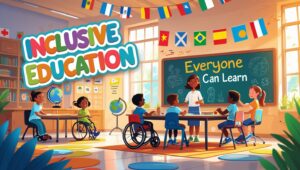
Inclusive education means a fair system that gives every student, regardless of their background, ability, or learning style, equal opportunity to learn. Its basic aim is that every child accepts himself or herself in his or her school or classroom and does not feel any kind of discrimination. Inclusive education is not just for students with disabilities or special needs, but for every student who does not fit into the mainstream system for one reason or another. It also includes students with language barriers, slow learners, gifted students, or cultural differences.
In today’s modern era, the purpose of education is not just to impart knowledge but also to provide every individual with a safe and supportive environment where they can perform to their full capacity. When we implement inclusive education, we build a society that is based on empathy, equality, and respect. Understanding the unique needs of each student and providing support accordingly is a core part of inclusive education. This leads to not only academic success but also emotional and social development. When everyone has equal rights, not just an individual but the entire society benefits. Therefore, inclusive education is not just a necessity, it is a responsibility that every educator and the system should fulfill.
- Understanding Learner Diversity – Types of Needs in a Classroom
Every classroom has a diversity of students, and each student has a different learning style and needs. The first step to inclusive education is to understand that not every learner is the same. Some students have physical disabilities, such as hearing or visual impairments. Some have learning disabilities, such as dyslexia or ADHD. Some have language barriers, while others are gifted and at an advanced level learner who requires challenging content.
There are also emotional and behavioral challenges that impact learning. Some students are socially anxious, some have home issues, and some cannot adjust because of cultural or religious backgrounds. An inclusive classroom does not mean that the same method is used for everyone. Rather, it requires that the specific needs of each student be identified and teaching methods be adapted accordingly.
When a teacher begins to understand learner diversity, he or she plans and designs better and more flexible teaching. This process not only helps academically, it also makes students emotionally confident and socially connected. When students feel understood, their confidence increases and they actively participate in learning. Appreciating diversity is a fundamental pillar of inclusive education.
- Creating a Supportive Learning Environment for All
An inclusive classroom is successful only when the atmosphere is safe, welcoming, and supportive for every student. It is the teacher’s responsibility to develop such an environment where no child feels excluded. When students feel that their identity, culture, and abilities are being respected, they can learn better.
Supportive environment means that students get encouragement all the time, their progress is appreciated, and their mistakes are considered as a learning opportunity. The classroom setup should also be inclusive, such as space for wheelchair users, colorful charts for visual learners, and repeated instructions for slow learners.
The teacher’s attitude should also be inclusive – regardless of judgment, every student should be dealt with patience and understanding. Peer support is also very important, where students help each other and work together. Using tools such as group work, cooperative activities, and interactive learning develop bonding among students.
Parents should also be involved so that they can gain trust and cooperation. When school and home together contribute to a student’s growth, his or her confidence and performance both improve. Inclusive education is not just about physical changes, it also requires a positive shift in mindset and environment.
- Instructional Strategies for Inclusive Classrooms:
In inclusive classrooms, each student has different learning needs, so teachers need to adopt flexible and diverse teaching strategies. The first and foremost strategy is differentiated instruction. This means adjusting a single lesson to suit different students’ abilities. For example, diagrams and videos for visual learners, and discussions or audio recordings for auditory learners.
Another important technique is scaffolding, in which the teacher gives step-by-step guidance to students until they become self-dependent. Cooperative learning is also effective for inclusive classrooms. When students work in groups, they help each other and develop social skills.
Universal Design for Learning (UDL) is a more modern approach where teaching material is designed to be accessible to the maximum number of students. It includes multiple formats, assessment options, and participation methods.
Regular feedback and assessment tools should also be adjustable; each student should be judged according to their strengths. Oral presentations, projects, visuals, or written exams each have their own method.
The goal of all these strategies is to ensure that no student is left behind. When a teacher personalizes learning, students feel motivated and engaged. Inclusive teaching means creating a learning experience that is meaningful and accessible to every student.
- Role of Teachers, Parents, and Community in Inclusive Education
Inclusive education is not just the teacher’s work, it is a collective effort in which teachers, parents, and the community play an active role. The foremost role is that of the teacher, who is the leader of the classroom. The teacher has to understand the needs of each student, design suitable strategies for them, and build their confidence.
Teachers also need continuous training and workshops so that they can learn new teaching methods and inclusive practices. But the role of parents is no less. When parents are interested in their children’s learning, communicate with them regularly, and get involved in school activities, students feel more secure and motivated.
The community can also provide a strong support system in inclusive education. NGOs, local organizations, and educational volunteers can provide special learning resources or support services. Acceptance and understanding can be developed in society by running inclusive campaigns and awareness programs.
Inclusive education only works when all stakeholders work for a single goal. When teachers, parents, and the community work together to support a student, not only the student benefits, but the school and society also become stronger. Everyone’s role is important so that inclusive education does not remain just a theory, but becomes a ground reality.
- Conclusion:
Inclusive education is a concept that is beneficial not just for a particular group but for every student. When we respect and give equal opportunity to every learner, we build a society that is based on empathy, tolerance, and cooperation. The future of inclusive education will be bright only when teachers continuously learn, parents actively participate, and the system is flexible and adaptive.
Work should also be done at the policy level to make the education systems of the future inclusive. Diversity should be taken care of at every step from curriculum designing to classroom training. Technology can also be a powerful tool to support inclusive education – such as assistive apps, online learning tools, and digital classrooms.
The most important thing is that we develop the values of acceptance and inclusivity in students from childhood. When a student learns to accept the differences of another student, he becomes not just a good learner but also a good human being.
Today’s time makes inclusive education not just an option but a necessity. It is the duty of every school, every teacher, and every parent to adopt inclusive practices so that we can give every child their rights to learn, to understand, and to grow.
FAQs:
- What is inclusive education and why is it important?
Inclusive education means providing every student, regardless of their abilities or backgrounds, an equal opportunity to learn in a supportive and discrimination-free environment. It’s important because it promotes empathy, equality, and helps every learner reach their full potential academically, socially, and emotionally. - How can teachers accommodate diverse learners in the classroom?
Teachers can accommodate diverse learners by understanding their unique needs, using flexible teaching methods like differentiated instruction, scaffolding, and cooperative learning, and creating an environment that respects all cultures and abilities. - What does a supportive learning environment look like in inclusive education?
A supportive learning environment is safe, welcoming, and respectful where students feel valued and encouraged. It includes physical accessibility, positive teacher attitudes, peer support, and active involvement of parents to help students thrive. - What roles do teachers, parents, and the community play in inclusive education?
Teachers lead by understanding and meeting student needs, parents support learning by staying engaged, and the community provides resources and awareness. Together, they create a strong network that helps students succeed and makes inclusion a reality. - How can technology support inclusive education?
Technology supports inclusive education through assistive apps, online learning tools, and digital classrooms that make learning accessible to students with different needs and learning styles, helping to personalize education for everyone.